Sentinel-1 SLC Burst Selection with EOPFZARR GDAL Driver
Directly access individual bursts from Sentinel-1 SLC products using the BURST open option

Sentinel-1 SLC Burst Selection with EOPFZARR GDAL Driver
Run this notebook interactively with all dependencies pre-installed
Table of Contents
Introduction
Sentinel-1 SLC (Single Look Complex) products in IW (Interferometric Wide) mode contain many bursts spread across multiple subswaths and polarizations. A typical IW dual-pol product has 54 bursts (9 bursts × 3 subswaths × 2 polarizations), producing over 1000 subdatasets.
The EOPFZARR GDAL driver provides a BURST open option with a friendly naming scheme to directly select a specific burst without navigating the full subdataset list.
Setup
import numpy as np
import matplotlib.pyplot as plt
from osgeo import gdal

gdal.UseExceptions()

print(f"GDAL version: {gdal.__version__}")
drv = gdal.GetDriverByName("EOPFZARR")
print(
    f"EOPFZARR driver: {'registered' if drv else 'NOT FOUND — install the EOPFZARR plugin'}"
)
GDAL version: 3.12.0dev-209c099c56
EOPFZARR driver: registered
/home/yadagale/.local/lib/python3.10/site-packages/matplotlib/projections/__init__.py:63: UserWarning: Unable to import Axes3D. This may be due to multiple versions of Matplotlib being installed (e.g. as a system package and as a pip package). As a result, the 3D projection is not available.
  warnings.warn("Unable to import Axes3D. This may be due to multiple versions of "
Product Definition
We use a Sentinel-1C IW SLC product with dual VV/VH polarization, stored in EOPF Zarr format on the EODC notebook-data stable bucket.
SLC_URL = (
    "/vsicurl/https://objects.eodc.eu/e05ab01a9d56408d82ac32d69a5aae2a:"
    "notebook-data/tutorial_data/cpm_v262/"
    "S1C_IW_SLC__1SDV_20251016T165627_20251016T165654_004590_00913B_30C4.zarr"
)

print("Product: S1C_IW_SLC__1SDV_20251016T165627")
print("Mode:    IW SLC, Dual VV/VH polarization")
Product: S1C_IW_SLC__1SDV_20251016T165627
Mode: IW SLC, Dual VV/VH polarization
Explore Product Structure
Without the BURST option, opening an SLC product exposes all subdatasets — over 1000 paths for a typical dual-pol IW product. The BURST option simplifies this.
ds = gdal.Open(f"EOPFZARR:'{SLC_URL}'")

subdatasets = ds.GetMetadata("SUBDATASETS")
all_names = sorted([v for k, v in subdatasets.items() if "_NAME" in k])
slc_names = [s for s in all_names if "measurements/slc" in s]

print(f"Total subdatasets:           {len(all_names)}")
print(f"SLC measurement subdatasets: {len(slc_names)}")
print("\nFirst 5 SLC subdatasets:")
for s in slc_names[:5]:
    print(f"  {s.split('/')[-3]}/{s.split('/')[-2]}/{s.split('/')[-1]}")
print(f"  ... and {len(slc_names) - 5} more")

ds = None
Total subdatasets: 1296
SLC measurement subdatasets: 54
First 5 SLC subdatasets:
S01SIWSLC_20251016T165627_0027_C026_30C4_00913B_VH_IW1_92598/measurements/slc
S01SIWSLC_20251016T165627_0027_C026_30C4_00913B_VH_IW1_92599/measurements/slc
S01SIWSLC_20251016T165627_0027_C026_30C4_00913B_VH_IW1_92600/measurements/slc
S01SIWSLC_20251016T165627_0027_C026_30C4_00913B_VH_IW1_92601/measurements/slc
S01SIWSLC_20251016T165627_0027_C026_30C4_00913B_VH_IW1_92602/measurements/slc
... and 49 more
Select a Burst
Use the BURST open option to select a burst directly by its friendly name: {subswath}_{polarization}_{index}.
ds_burst = gdal.OpenEx(
    f"EOPFZARR:'{SLC_URL}'",
    gdal.OF_RASTER | gdal.OF_READONLY,
    open_options=["BURST=IW1_VV_001"],
)

print(f"Dimensions:          {ds_burst.RasterXSize} x {ds_burst.RasterYSize} pixels")
print(f"Bands:               {ds_burst.RasterCount}")
print(
    f"Data type:           {gdal.GetDataTypeName(ds_burst.GetRasterBand(1).DataType)}"
)
print(f"EOPF_BURST_NAME:     {ds_burst.GetMetadataItem('EOPF_BURST_NAME')}")
print(f"EOPF_BURST_SUBSWATH: {ds_burst.GetMetadataItem('EOPF_BURST_SUBSWATH')}")
print(f"EOPF_BURST_POLARIZATION: {ds_burst.GetMetadataItem('EOPF_BURST_POLARIZATION')}")
print(f"EOPF_BURST_INDEX:    {ds_burst.GetMetadataItem('EOPF_BURST_INDEX')}")
Dimensions: 23261 x 1501 pixels
Bands: 1
Data type: CFloat32
EOPF_BURST_NAME: IW1_VV_001
EOPF_BURST_SUBSWATH: IW1
EOPF_BURST_POLARIZATION: VV
EOPF_BURST_INDEX: 1
Compare Bursts Across Subswaths
IW mode uses three subswaths (IW1, IW2, IW3). Each has a different incidence angle and spatial extent.
subswaths = ["IW1", "IW2", "IW3"]
burst_datasets = {}

print(f"{'Subswath':<10} {'Burst':<14} {'Width':<8} {'Height':<8} {'Type'}")
print("-" * 55)

for sw in subswaths:
    burst_name = f"{sw}_VV_001"
    ds = gdal.OpenEx(
        f"EOPFZARR:'{SLC_URL}'",
        gdal.OF_RASTER | gdal.OF_READONLY,
        open_options=[f"BURST={burst_name}"],
    )
    if ds:
        burst_datasets[sw] = ds
        dtype = gdal.GetDataTypeName(ds.GetRasterBand(1).DataType)
        print(
            f"{sw:<10} {burst_name:<14} {ds.RasterXSize:<8} {ds.RasterYSize:<8} {dtype}"
        )
Subswath Burst Width Height Type
-------------------------------------------------------
IW1 IW1_VV_001 23261 1501 CFloat32
IW2 IW2_VV_001 27012 1511 CFloat32
IW3 IW3_VV_001 25954 1516 CFloat32
Visualize Burst Amplitude
SLC data is complex-valued (CFloat32). We compute amplitude and convert to dB for visualization.
fig, axes = plt.subplots(1, 3, figsize=(15, 5))

for idx, (sw, ds) in enumerate(burst_datasets.items()):
    # Read a 500x500 centre crop
    xoff = (ds.RasterXSize - 500) // 2
    yoff = (ds.RasterYSize - 500) // 2
    data = ds.GetRasterBand(1).ReadAsArray(xoff, yoff, 500, 500)

    amp_db = 10 * np.log10(np.abs(data) + 1)
    vmin, vmax = np.nanpercentile(amp_db, [2, 98])

    axes[idx].imshow(amp_db, cmap="gray", vmin=vmin, vmax=vmax)
    axes[idx].set_title(f"{sw}_VV_001", fontweight="bold")
    axes[idx].set_xlabel("Range (pixels)")
    axes[idx].set_ylabel("Azimuth (pixels)")

plt.suptitle(
    "SLC Amplitude (dB) — First VV Burst per Subswath", fontsize=13, fontweight="bold"
)
plt.tight_layout()
plt.show()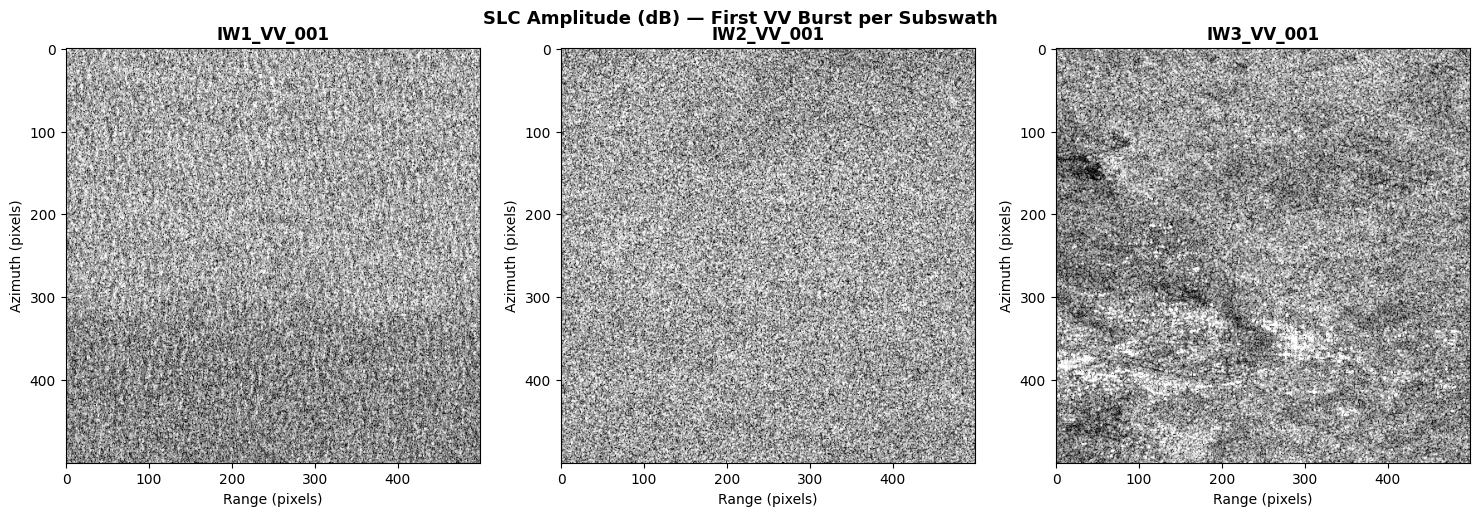
Compare Polarizations
VV (co-polarization) and VH (cross-polarization) capture different scattering characteristics from the same scene.
ds_vv = gdal.OpenEx(
    f"EOPFZARR:'{SLC_URL}'", gdal.OF_RASTER, open_options=["BURST=IW1_VV_001"]
)
ds_vh = gdal.OpenEx(
    f"EOPFZARR:'{SLC_URL}'", gdal.OF_RASTER, open_options=["BURST=IW1_VH_001"]
)

xoff = (ds_vv.RasterXSize - 500) // 2
yoff = (ds_vv.RasterYSize - 500) // 2

vv_amp = 10 * np.log10(
    np.abs(ds_vv.GetRasterBand(1).ReadAsArray(xoff, yoff, 500, 500)) + 1
)
vh_amp = 10 * np.log10(
    np.abs(ds_vh.GetRasterBand(1).ReadAsArray(xoff, yoff, 500, 500)) + 1
)

fig, axes = plt.subplots(1, 2, figsize=(12, 5))
for ax, data, title in zip(
    axes, [vv_amp, vh_amp], ["IW1_VV_001 (Co-pol)", "IW1_VH_001 (Cross-pol)"]
):
    vmin, vmax = np.nanpercentile(data, [2, 98])
    ax.imshow(data, cmap="gray", vmin=vmin, vmax=vmax)
    ax.set_title(title, fontweight="bold")
    ax.set_xlabel("Range (pixels)")
    ax.set_ylabel("Azimuth (pixels)")

plt.suptitle("VV vs VH Polarization — IW1 Burst 001", fontsize=13, fontweight="bold")
plt.tight_layout()
plt.show()

ds_vv = ds_vh = None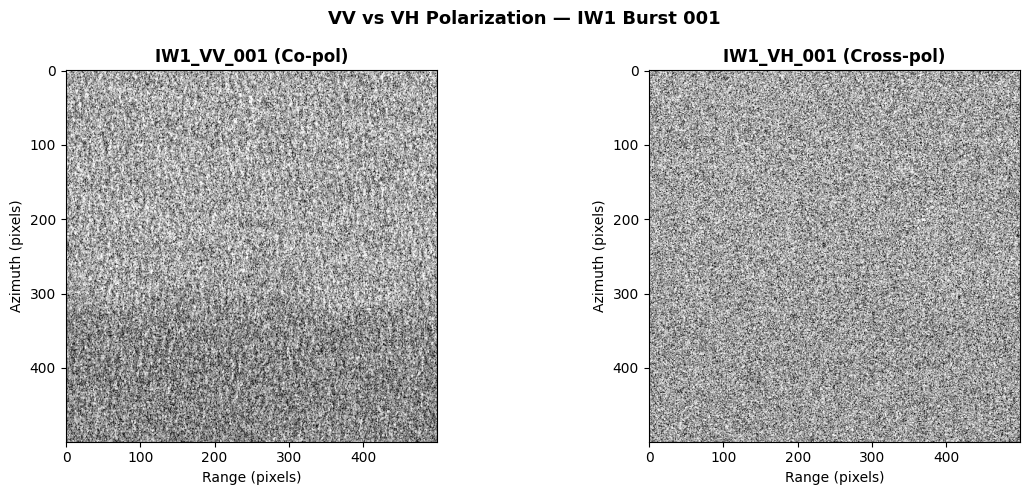
Summary
The BURST open option in the EOPFZARR driver provides direct access to individual Sentinel-1 SLC bursts by friendly name, without navigating hundreds of subdatasets.
| Feature | Description |
|---|---|
| Naming scheme | {subswath}_{polarization}_{index} e.g. IW1_VV_001 |
| Case insensitive | iw1_vv_001 and IW1_VV_001 are equivalent |
| Data type | CFloat32 (complex single-precision) |
| Metadata | Burst name, subswath, polarization, and index exposed via GDAL metadata |
# Open a specific burst
ds = gdal.OpenEx(
    "EOPFZARR:'/vsicurl/...SLC...zarr'",
    open_options=["BURST=IW1_VV_001"]
)
amplitude = np.abs(ds.GetRasterBand(1).ReadAsArray())
# Command line
gdalinfo "EOPFZARR:'/vsicurl/...SLC...zarr'" -oo BURST=IW1_VV_001# Cleanup
for ds in burst_datasets.values():
ds = None
burst_datasets.clear()
if "ds_burst" in dir():
ds_burst = None
print("Done.")Done.
